

English
Application lifecycle
This guide covers the phases of an application:
bin/server.ts— the entry point- Ignitor constructor
- Builder methods
- Phase 1 — REGISTER
- Phase 2 — BOOT
- Phase 3 — START
- Phase 4 — READY
- Shutdown
- Application hooks
- Environment properties
- Service singletons
- Lifecycle summary
- Execution order
- Practical rules
- Recommendation
- Lifecycle (critical)
Ream follows a four-phase startup sequence. Every provider, preload file, and module route file has a defined moment when it runs. Understanding this sequence tells you exactly where to put initialization code.
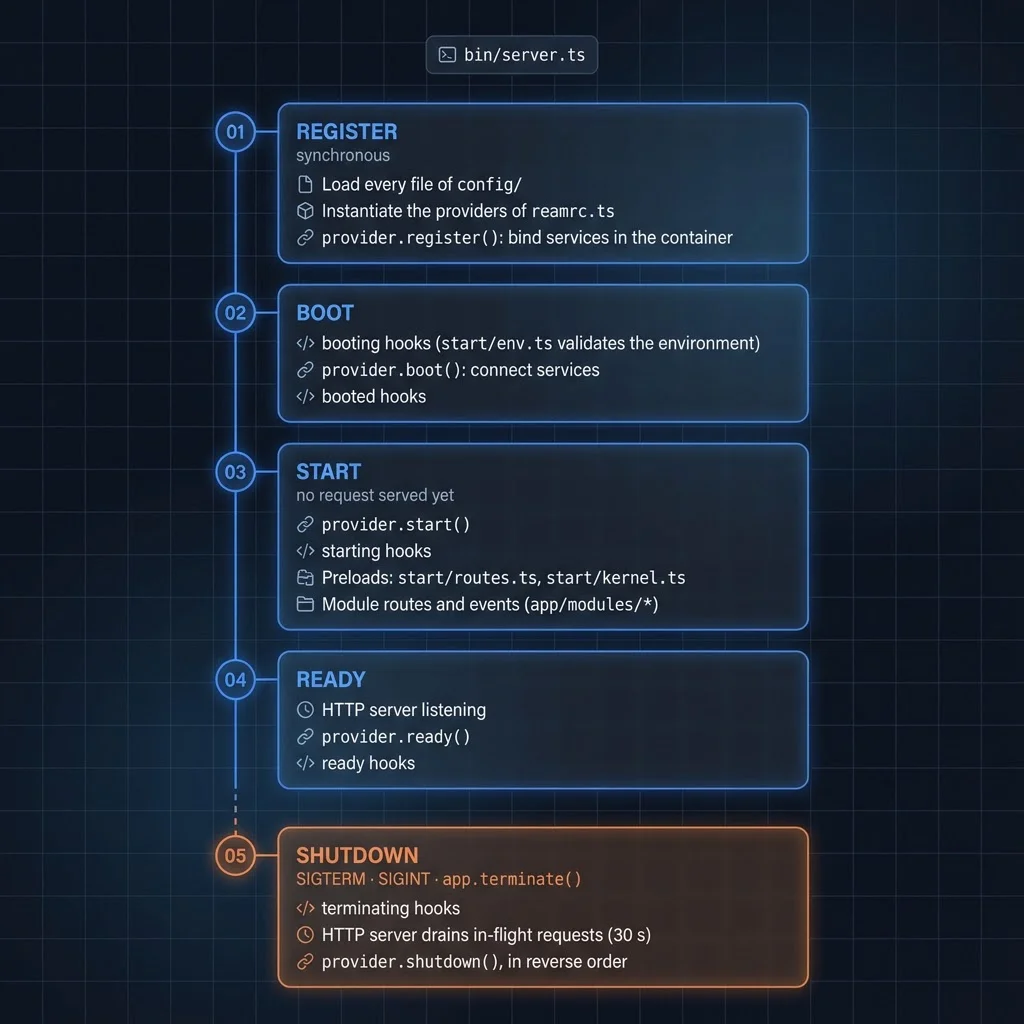
bin/server.ts — the entry point
The canonical entry point for a Ream HTTP server:
typescript
// bin/server.ts
import { Ignitor, prettyPrintError } from '@c9up/ream'

const APP_ROOT = new URL('../', import.meta.url)

new Ignitor(APP_ROOT, { port: 3000 })
  .tap((app) => {
    app.listen('SIGTERM', () => app.terminate())
    app.listenIf(app.managedByPm2, 'SIGINT', () => app.terminate())
  })
  .useRcFile((await import('../reamrc.js')).default)
  .httpServer()
  .start()
  .catch((error) => {
    process.exitCode = 1
    prettyPrintError(error)
  })
reflect-metadata
Constructor injection reads the constructor types that TypeScript records on a decorated class (emitDecoratorMetadata). TypeScript only records them if the reflect-metadata package is loaded before the class is defined. Otherwise it skips them without an error, and the container has nothing to inject.
You do not import it yourself. @c9up/ream loads it at the top of its entry, and so do @c9up/atlas and @c9up/warden. A module runs its imports before its own code. So a class that imports @inject(), @Column() or @Guard() from these packages is always defined after reflect-metadata is loaded.
One case needs care: a class decorated only with your own decorator (or another library's), in a file that runs before anything imports @c9up/ream. Keep @c9up/ream as the first import of bin/server.ts, as above, and this cannot happen.
Your package.json does not need to list reflect-metadata either: @c9up/ream depends on it. The ream commands load it through @c9up/ream, and the files ream new writes do not import it.
Ignitor constructor
typescript
new Ignitor(APP_ROOT, config)| Parameter | Type | Description |
|---|---|---|
APP_ROOT | URL | new URL('../', import.meta.url) from bin/server.ts |
config.port | number | Port to listen on (default 3000) |
config.host | string | Address to bind to. Falls back to process.env.HOST, then 0.0.0.0 in production and localhost elsewhere |
config.serverFactory | (port: number, host: string) => HyperServerLike | Factory that creates the HTTP server instance |
config.importer | (filePath: string) => Promise<unknown> | Custom module loader (optional) |
config.watchDirs | string[] | Directories to watch for hot-reload in dev mode |
The constructor immediately registers framework services in the container ('router', 'server', 'middleware', 'app') and initializes the service singletons so route files can import them.
Builder methods
The Ignitor uses a fluent builder API. All methods except .start() return this.
.tap(callback)
Access the Application instance before the lifecycle starts. Use it for signal handlers and booting/booted hooks.
typescript
.tap((app) => {
  app.listen('SIGTERM', () => app.terminate())
  app.listenIf(app.managedByPm2, 'SIGINT', () => app.terminate())

  app.booting(async () => {
    // runs at the start of the BOOT phase, before providers boot
  })

  app.booted(async () => {
    // runs after all providers have booted
  })
})
.useRcFile(reamrc)
Load the application configuration. Pass the default export of reamrc.ts.
typescript
.useRcFile((await import('../reamrc.js')).default).httpServer()
Sets the environment to 'web'. Required before .start() when running an HTTP server. Validates that a serverFactory was provided.
.start()
Runs all four lifecycle phases in order. Returns Promise<Ignitor>. Chain .catch(prettyPrintError) to handle boot-time failures gracefully.
Phase 1 — REGISTER
What happens, in order:
- The Ignitor scans the
config/directory and imports every.ts/.jsfile it finds. Each file's default export is stored inapp.configunder its filename (e.g.,config/database.ts→app.config.get('database')). - Each provider listed in
reamrc.providersis imported and instantiated. provider.register()is called synchronously on each provider in list order.
register() is the only synchronous lifecycle method. Do not perform async work here. Do not resolve services that depend on other providers — those providers may not have registered yet.
typescript
export default class AtlasProvider extends Provider {
  register(): void {
    this.app.container.singleton('db', () => {
      return new DatabaseManager(this.app.config.get('database'))
    })
  }
}
Phase 2 — BOOT
What happens, in order:
app.booting()hooks run (registered via.tap()).provider.boot()is called on each provider in list order.app.booted()hooks run.
By the time boot() runs, every provider has already registered its bindings. It is safe to resolve other services here.
typescript
export default class AtlasProvider extends Provider {
  async boot(): Promise<void> {
    const db = await this.app.container.make<DatabaseManager>('db')
    await db.connect()
    await db.query('SELECT 1') // verify the connection
  }
}
Phase 3 — START
What happens, in order:
provider.start()is called on each provider.app.starting()hooks run.- Preload files from
reamrc.preloadsare imported. This is whenstart/kernel.tsruns and sets up server middleware. - Module routes are auto-loaded. The Ignitor reads
reamrc.modules.path, scans each subdirectory, and imports any file namedroutes.ts(or the filenames listed inreamrc.modules.autoload).
The HTTP server is not yet accepting requests during this phase. This is the right moment to define routes, register named middleware, and warm caches.
typescript
// start/kernel.ts
import server from '@c9up/ream/services/server'
import router from '@c9up/ream/services/router'

server.errorHandler(() => import('../app/exceptions/Handler.js'))
server.use([() => import('../app/middleware/RequestId.js')])

router.use([() => import('../app/middleware/Auth.js')])
typescript
// app/modules/users/routes.ts
import router from '@c9up/ream/services/router'
import UsersController from './UsersController.js'

router.get('/users', [UsersController, 'index'])
router.get('/users/:id', [UsersController, 'show'])
router.post('/users', [UsersController, 'store'])
Phase 4 — READY
What happens, in order:
- The
Serverinstance is booted (resolves the lazy error handler). - The HTTP server is started —
serverFactoryis called,onRequestis wired to the kernel, andlisten()is awaited. - The error boundary is installed (catches unhandled rejections and
uncaughtException). provider.ready()is called on each provider.app.ready()hooks run.- Hot-reload watcher starts in dev mode, then the application is marked ready (
app.isReady).
After ready() returns, the application is fully operational. Log your readiness message here.
typescript
export default class AppProvider extends Provider {
  async ready(): Promise<void> {
    console.log('Application ready — accepting requests')
  }
}
Shutdown
Shutdown is triggered by app.terminate() (called from signal handlers) or by ignitor.stop(). app.terminate() runs the terminating hooks in reverse order, then shuts the providers down; the Ignitor that opened the HTTP server registers a terminating hook that calls ignitor.stop(), so every path drains the server. The ignitor.stop() sequence is:
- The hot-reload watcher is stopped.
- The HTTP server is closed (no new connections accepted, in-flight requests drain).
- The error boundary is uninstalled.
provider.shutdown()is called on providers in reverse registration order.
When it starts an HTTP server, the Ignitor installs its own SIGTERM / SIGINT handlers (pass gracefulShutdown: false in the Ignitor config to opt out). The first signal runs app.terminate() with a 30-second drain timeout; the process then exits with 0, or 1 when the shutdown threw or the drain ran out of time. A second signal during the drain exits with 1 at once.
typescript
export default class AtlasProvider extends Provider {
  async shutdown(): Promise<void> {
    const db = await this.app.container.make<DatabaseManager>('db')
    await db.disconnect()
  }
}
Application hooks
Register hooks inside .tap() before calling .start().
typescript
new Ignitor(APP_ROOT, config)
  .tap((app) => {
    // Runs at the start of BOOT, before providers boot
    app.booting(async () => {
      await import('./start/env.js') // validate environment variables
    })

    // Runs after all providers have booted
    app.booted(async () => {
      console.log('All providers booted')
    })

    // Handle OS signals for graceful shutdown
    app.listen('SIGTERM', () => app.terminate())

    // Only attach SIGINT handler when managed by PM2
    app.listenIf(app.managedByPm2, 'SIGINT', () => app.terminate())
  })
app.listen(signal, callback)
Attaches a process.on(signal, callback) listener.
app.listenIf(condition, signal, callback)
Same as app.listen(), but only attaches if condition is true. Used with app.managedByPm2 to avoid intercepting SIGINT (Ctrl+C) in local development.
app.terminate()
Runs the terminating hooks in reverse order (the HTTP server's close is one of them), then app.shutdown() (all providers in reverse order). A second call while one is running is ignored. It does not close the server itself and does not call process.exit(): the process ends when nothing holds the event loop any more, or when the Ignitor's signal handler finishes its drain (see Shutdown).
app.terminating(callback)
Registers a hook that app.terminate() runs before shutting the providers down — last registered, first run. Whatever opens a socket or a long-lived handle registers the hook that closes it.
app.booting(callback)
Registers a callback that runs at the start of the BOOT phase, before any provider's boot() method.
app.booted(callback)
Registers a callback that runs after all providers have booted. If called after the app is already booted, the callback runs immediately.
app.starting(callback)
Registers a callback that runs during the START phase, after every provider's start() and before the preload files. A warm-up runs it too. Returns the application, so calls chain.
app.ready(callback)
Registers a callback that runs once every provider's ready() has returned, before the application is marked ready. Called on an application that is already ready, the callback runs at once (await app.ready(...) waits for it). A callback that throws fails the start.
typescript
app.ready(async () => {
  await warmCaches()
})
app.import(id) and app.importDefault(id)
Import a module through the importer the application was given (new Ignitor(APP_ROOT, { importer: (filePath) => import(filePath) })), so a # subpath such as #listeners/send_email resolves against the application's package.json. importDefault returns the default export and names the module when it has none; it also accepts a thunk (() => import('./x.js')). Without an importer, both throw E_APP_MISSING_IMPORTER.
Environment properties
typescript
app.inProduction  // process.env.NODE_ENV === 'production'
app.inDev         // NODE_ENV is not 'production' and not 'test'
app.inTest        // process.env.NODE_ENV === 'test'
app.managedByPm2  // 'PM2_HOME' or 'pm_id' is in process.env
Service singletons
Three singleton proxies are initialized by the Ignitor before any preload file runs. Import them in route files, kernel files, and providers.
@c9up/ream/services/app
typescript
import app from '@c9up/ream/services/app'

await app.container.make(MyService)
app.config.get('database')
app.inProduction
@c9up/ream/services/router
typescript
import router from '@c9up/ream/services/router'

router.get('/health', ({ response }) => response.json({ status: 'ok' }))
router.group('/api/v1', () => {
  router.get('/users', [UsersController, 'index'])
})
@c9up/ream/services/server
typescript
import server from '@c9up/ream/services/server'

server.errorHandler(() => import('../app/exceptions/Handler.js'))
server.use([() => import('../app/middleware/RequestId.js')])
All three are Proxy objects that delegate to the underlying instance. Accessing them before the Ignitor constructs throws a descriptive error.
Lifecycle summary
| Phase | Triggered by | Async | Purpose |
|---|---|---|---|
| REGISTER | phaseRegister() | No (register) | Auto-load config, register container bindings |
| BOOT | phaseBoot() | Yes | Connect services, run booting/booted hooks |
| START | phaseStart() | Yes | Import preloads, auto-load module routes, call start() |
| READY | phaseReady() | Yes | Start HTTP server, call ready() |
| SHUTDOWN | stop() / terminate() | Yes | Reverse-order provider cleanup |
Execution order
registerbootstartreadyshutdown
Practical rules
register: IoC bindings, no heavy IOboot: DB/bus/cache initializationstart: open HTTP/console runtimeready: app is servingshutdown: graceful teardown
Recommendation
Test shutdown explicitly (SIGTERM/SIGINT) to validate long-lived resource cleanup.
Lifecycle (critical)
Execution order:
register- container bindings, config, providers.boot- external deps initialization.start- server/runtime start.ready- app is operational.shutdown- graceful teardown.
Practical rule:
register: no blocking IO.boot: DB/bus/cache connections.shutdown: close resources, workers, timers.
Next steps
- Providers — Writing providers for each lifecycle phase
- IoC Container — Dependency injection and service resolution
- Routing — Defining routes in module route files