

English
WebSockets
This guide covers WebSocket routes:
- Declaring a WebSocket route
- The handshake decides
- The socket
- Limits
- Testing a WebSocket route
- Errors
- WebSockets
ream's native server accepts WebSocket connections on routes you declare like any other, behind the same middleware and guards. On top of that, three packages speak a protocol over the socket for you:
| You want | Use |
|---|---|
| Your own messages, your own format | router.ws(), below |
| Request / response calls to server methods | JSON-RPC over a WebSocket with the RpcRouter, and comet's WebSocket transport as the client |
| Hubs, groups and broadcasts, with a stock SignalR client | relay hubs, which pick WebSockets when the server can upgrade |
Declaring a WebSocket route
router.ws() declares a route that accepts WebSocket connections. It is a GET route like any other — it takes .as(), .use(), .middleware(), groups and prefixes — and its handler receives the context with a socket on it:
typescript
// start/routes.ts
import router from '@c9up/ream/services/router'

router.ws('/chat/:room', ({ socket, params, auth }) => {
  socket.send(JSON.stringify({ joined: params.room, user: auth.user?.id }))

  socket.on('message', (data, isBinary) => {
    // data: a string for a text message, a Uint8Array for a binary one
    socket.send(data)
  })

  socket.on('close', (code, reason) => {
    // the client left, the connection dropped (1006), or the server closed it
  })
}).use(middleware.auth())
Attach the listeners in the handler: messages can arrive as soon as the handshake completes, and one with no message listener is dropped.
A path can carry a GET route and a WebSocket route at once: the handshake goes to router.ws(), a plain GET to router.get(), whatever the order they were declared in. A SignalR hub does it — its Server-Sent Events stream and its socket share the URL. Two WebSocket routes on one path are refused (E_DUPLICATE_ROUTE), as two GET routes are.
The handshake decides
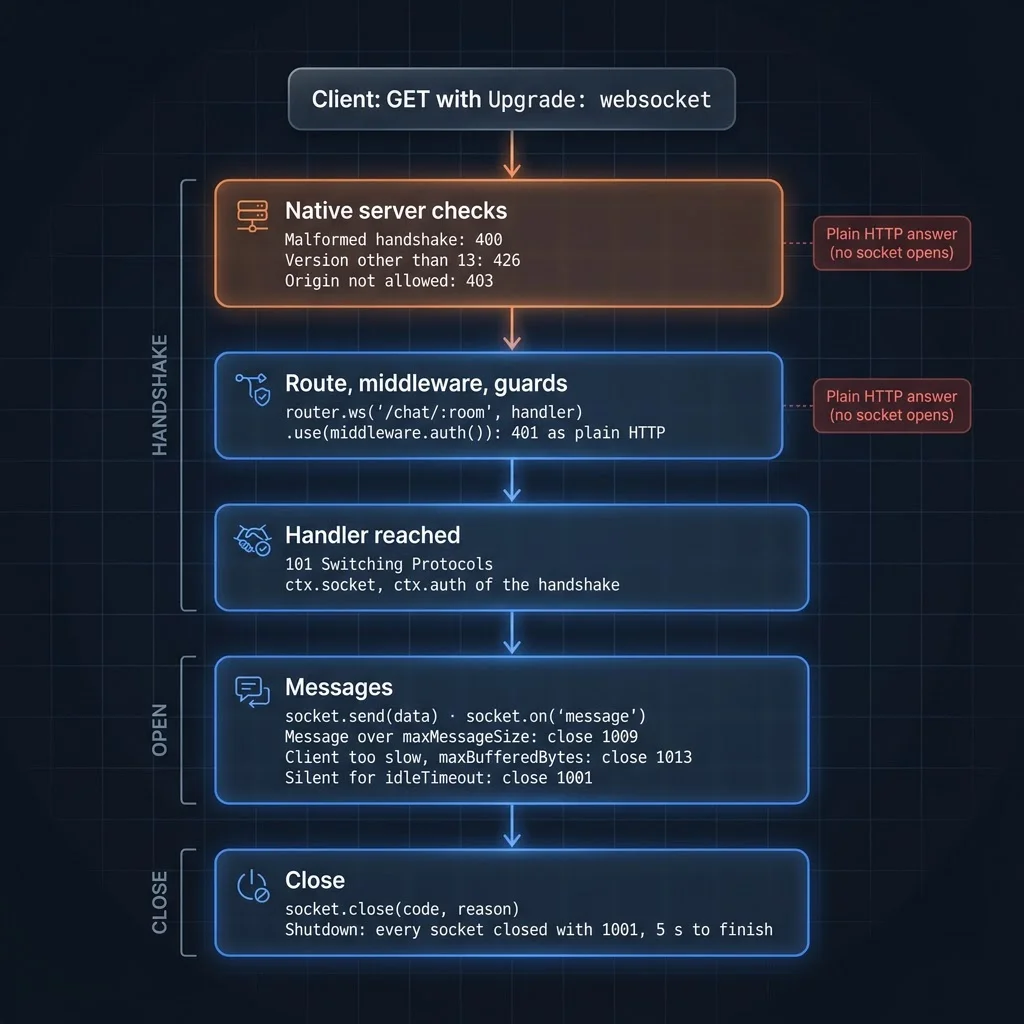
A WebSocket connection starts as an HTTP request, the handshake. Everything a route does with a request happens to it, before any socket exists:
- The server itself refuses, before routing, a malformed handshake (
400 E_WEBSOCKET_BAD_HANDSHAKE), a WebSocket version other than 13 (426 E_WEBSOCKET_VERSION), and a browserOriginit does not allow (403 E_WEBSOCKET_ORIGIN, see Origins). - The route is matched, then its middleware and guards run. A client the auth middleware refuses gets its
401as a plain HTTP answer and never an open connection. - Only once the handler is reached is the request answered
101 Switching Protocols. A handler that throws answers like any other route, and no socket opens.
A plain GET to a WebSocket route is answered 426 E_WEBSOCKET_UPGRADE_REQUIRED with Upgrade: websocket. A WebSocket route reached on a server that cannot hold WebSockets is answered 501 E_WEBSOCKET_UNSUPPORTED.
Auth lasts for the connection
A socket has one request: its handshake. The ctx the handler receives — ctx.auth, the session, ctx.params — is that request's for as long as the socket stays open, so a role removed while the user is connected only counts from their next connection. When a user signs out or loses access, close their sockets yourself:
typescript
import type { ServerWebSocket } from '@c9up/ream'

const sockets = new Map<string, Set<ServerWebSocket>>()

router.ws('/notifications', ({ socket, auth }) => {
  const id = String(auth.user?.id)
  const mine = sockets.get(id) ?? new Set()
  mine.add(socket)
  sockets.set(id, mine)
  socket.on('close', () => mine.delete(socket))
}).use(middleware.auth())

// on sign-out
for (const socket of sockets.get(userId) ?? []) socket.close(1008, 'signed out')
The socket
On socket | |
|---|---|
send(data) | A string goes as text, a Uint8Array as binary. false when the socket is closing, or when the message would take the client's backlog past maxBufferedBytes — the connection is then closed with 1013 instead of buffering for a client that does not read. |
close(code?, reason?) | Closes once what is queued has been written, and at most 5 seconds after the call even if the client does not read. code is 1000 (default), 1001–1014, or 3000–4999; reason at most 123 bytes (otherwise E_WEBSOCKET_CLOSE_CODE, E_WEBSOCKET_CLOSE_REASON). |
on('message' | 'close', listener), off(...) | A listener that throws is reported, never allowed to take the process down. |
closed | A promise of { code, reason }: the client's close code, the server's, or 1006 when the connection dropped. |
bufferedAmount, readyState | Bytes waiting for the client; open, closing or closed. |
acceptProtocol(name), protocol, offeredProtocols | Choose, in the handler, one of the subprotocols the client offered (Sec-WebSocket-Protocol). Naming one it did not offer is E_WEBSOCKET_PROTOCOL. |
server.supportsWebSockets() (from @c9up/ream/services/server) says whether the server under the application accepts WebSocket connections: true once ream's native server is listening, false before it starts, after it stops, and on a host without the WebSocket primitives. A package asks it before it offers a WebSocket transport, as relay does.
Limits
Every connection is bounded before your code sees a byte. The limits live in the http.webSocket block of config/app.ts; the values below are the defaults:
typescript
// config/app.ts
export const http = {
  webSocket: {
    maxMessageSize: '1mb',     // largest incoming message
    maxFrameSize: '1mb',       // largest incoming frame
    idleTimeout: 60_000,       // ms of silence before the connection is closed; 0 never
    maxBufferedBytes: '4mb',   // what may wait for a client that reads slowly
    allowedOrigins: [],        // browser origins besides the request's own; ['*'] for any
  },
}| What happens | The server |
|---|---|
| A message or a frame over its limit | closes the connection with 1009 |
No traffic for idleTimeout | pings at half the timeout, closes with 1001 at the end |
| A client that stops reading | closes with 1013 once maxBufferedBytes would be passed — nothing past it is ever held in memory |
A write the client does not take for idleTimeout | closes with 1001 (idle timeout) and frees what was waiting for it |
socket.close() while a write to the client is stuck | ends the connection at most 5 seconds later; your close listener gets the code you passed |
| JavaScript does not take the messages in time | stops reading the socket until the messages already received have been handed to JavaScript. A message counts as handed over when its message listener is called, not when an async listener finishes: a listener that awaits does not slow the client down, so bound that work yourself |
| The application shuts down | closes every socket with 1001 and waits up to 5 seconds for them to finish |
A WebSocket counts toward http.maxConnections for as long as it is open (see Configuration). A size limit of 0 bytes is refused when the server starts (E_INVALID_WEBSOCKET_CONFIG).
Origins
A browser sends the site's cookies with a WebSocket handshake from any page, and WebSockets are not covered by the same-origin policy: without a check, any site a signed-in user visits could open a socket in their name (cross-site WebSocket hijacking). So by default only the request's own origin is accepted. List the others in allowedOrigins:
typescript
webSocket: {
  allowedOrigins: ['https://app.example.com', 'https://admin.example.com'],
}
A client that is not a browser sends no Origin and is not affected; its access is what the route's middleware and guards decide.
Not offered
WebSocket over HTTP/2 (RFC 8441) is not offered: browsers open WebSockets over HTTP/1.1. permessage-deflate compression is not negotiated. The server passes the Autobahn conformance suite without compression.
Testing a WebSocket route
TestClient.ws() opens a socket on the booted application, with the client's default headers. Messages queue until a test reads them; a refused handshake rejects with errors.E_TEST_CLIENT_WEBSOCKET_REFUSED, which carries the status.
typescript
import { errors } from '@c9up/ream'

const socket = await client.ws('/chat/general', { headers: { cookie } })
socket.send('hi')
expect(await socket.next()).toBe('hi')
socket.close()

await expect(client.ws('/chat/general')).rejects.toBeInstanceOf(errors.E_TEST_CLIENT_WEBSOCKET_REFUSED)
Errors
Every WebSocket error code, with its status, is in the error index.
WebSockets
router.ws() declares a route that accepts WebSocket connections. It is a GET route like any other — groups, prefixes, names and middleware apply — and the middleware and guards run on the handshake, before any socket opens:
typescript
router.ws('/chat/:room', ({ socket, params }) => {
  socket.on('message', (data) => socket.send(data))
}).use(middleware.auth())
The socket, its limits, origins and testing are in WebSockets.
Next Steps
- JSON-RPC over a WebSocket — the
RpcRouter's methods on a socket - comet — the JSON-RPC client's WebSocket transport, browser and Node
- relay — hubs, groups and broadcasts across instances
- Routing — groups, prefixes and named routes, which WebSocket routes share