

English
Introduction
This guide covers the OAuth 2.1 server:
- What it implements
- The decisions, and what each one prevents
- What
ream configurewrites - Not here yet
@c9up/visa is an OAuth 2.1 authorization server: it issues tokens to other applications on a user's behalf.
It authenticates nobody — that stays warden's job. Visa asks your application who is signed in, and owns everything after that. Its mirror image is transit, which consumes a provider; visa is one.
No dependencies: node:crypto only. A package sitting in the path that mints and compares credentials is a package that can replace them.
bash
ream configure @c9up/visa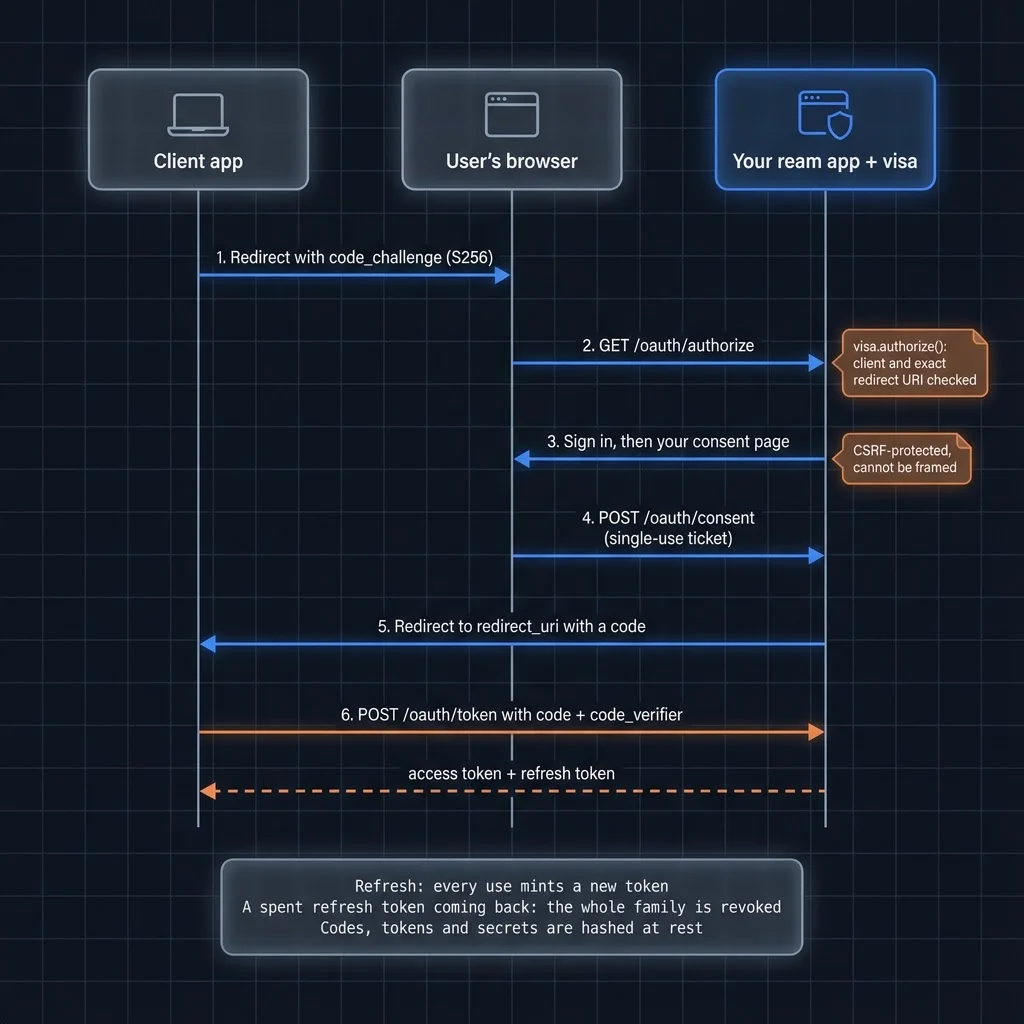
What it implements
| Grants | authorization_code (PKCE required), refresh_token, client_credentials |
| Endpoints | /oauth/token, /oauth/revoke, /oauth/introspect, /oauth/register, /.well-known/oauth-authorization-server, /.well-known/oauth-protected-resource |
| Also | RFC 9728 (where to authenticate), RFC 8707 (which server a token is for), RFC 7591 (clients that register themselves)* |
| Removed | implicit and password — gone from OAuth 2.1, and unavailable under any option |
* mounted only once declared in config/visa.ts.
/authorize is not mounted, and that is a decision rather than an omission: it needs a signed-in user and a consent screen, and both belong to your application. A route that guessed either would be wrong in a way that is hard to notice — a server showing no consent screen grants silently.
The decisions, and what each one prevents
- PKCE on every client, confidential ones included: a code on the front channel is interceptable whoever asked for it.
S256only.plainputs the verifier in the authorization request, so anything that can read that request — a log, a referrer, a proxy — can complete the exchange, which is exactly what PKCE exists to stop.allowPlainChallenge: truebrings it back.- Exact redirect URI matching, with the single exception the spec names (a loopback port, since a native app cannot know which port the OS will hand it). A prefix match is how an open redirect on the client's own domain becomes a stolen authorization code.
- An error is never redirected to an unverified URI. A bad
redirect_uriis shown to the user; bouncing it would tell an attacker the client exists and load a page of their choosing in the user's session. - Everything is hashed at rest — codes, access tokens, refresh tokens, client secrets. A database dump is not a set of working credentials.
- Refresh rotation with replay detection. Every use mints a new token; a spent one coming back proves a leak, and since there is no telling the thief from the victim, the whole family is revoked and both are signed out. Two presentations of the same token at the same time count too: the one that loses the race revokes the family, the winner's new tokens included.
- A replayed authorization code revokes what it bought. The legitimate exchange already happened, so the tokens in flight are the attacker's. The same holds when two exchanges of one code race.
- No silent consent for a client nothing identifies. A public client on a loopback,
localhostor private-use-scheme redirect URI sees the consent screen every time: another program on the machine could present its id. - The authorization response names its issuer (
iss, RFC 9207), so a client that uses several servers can tell where a code came from. - Parameters in the body only.
/oauth/token,/oauth/introspect,/oauth/revokeand/oauth/registerread the request body only, and answerinvalid_requestto a request that puts an OAuth parameter (client_secret,code,token,refresh_token, registration metadata on/oauth/register…) in the query string: a secret, a code or a token in a URL ends up in access logs, proxies and traces. Other query parameters are ignored. - A scope is not a permission. See Protecting a resource.
- One sentence per failure. "No such code", "expired", "already used" and "wrong client" all read
invalid_grant: The code is not valid.— telling them apart is how a code space gets probed.
Lifetimes
How long a leaked credential stays usable is configuration, in seconds:
| Key | Default | What it bounds |
|---|---|---|
accessTokenTtlSeconds | 3600 (an hour) | An access token, and the expires_in the token response carries. ream configure writes it explicitly. |
refreshTokenTtlSeconds | 2592000 (30 days) | A refresh token. Rotation mints a new one on every use. |
codeTtlSeconds | 30 | An authorization code: it is exchanged in milliseconds. |
consentTicketTtlSeconds | 600 (ten minutes) | A consent page: past it, the user's answer is refused. |
issueRefreshTokens | true | Whether refresh tokens exist at all. false and every session ends with its access token. |
A refresh token is issued only to a client whose grantTypes include refresh_token, and never on the client_credentials grant, where no user consented to anything.
Each lifetime is a positive whole number of seconds. Any other value stops the boot with E_VISA_INVALID_TTL.
What ream configure writes
bash
ream configure @c9up/visaFour things: VISA_ISSUER in .env, the provider in reamrc.ts, config/visa.ts with a MemoryStore and a comment saying to replace it, and the migrations for the five tables the atlas store reads — 9000_create_visa_tables and 9001_add_visa_client_secret_expiry. A migration already in the project is left alone. It fails before touching the project if those migrations cannot be read — a provider registered and a config written with no tables underneath is worse than stopping.
The store and the /authorize route stay yours — both are decisions rather than boilerplate, and a generated guess at either is wrong in a way that only shows up in production.
Once the provider is registered, the manager resolves by token and is typed:
ts
const visa = await container.make('visa') // VisaManager, not unknownNot here yet
OpenID Connect — id_token, discovery, JWKS, /userinfo. The nonce is already carried through the authorization code for it.