

English
Hubs
This guide covers SignalR hubs:
- Guarding a hub
- Ending a connection
- Invocation arguments
- What is not supported
- The wire
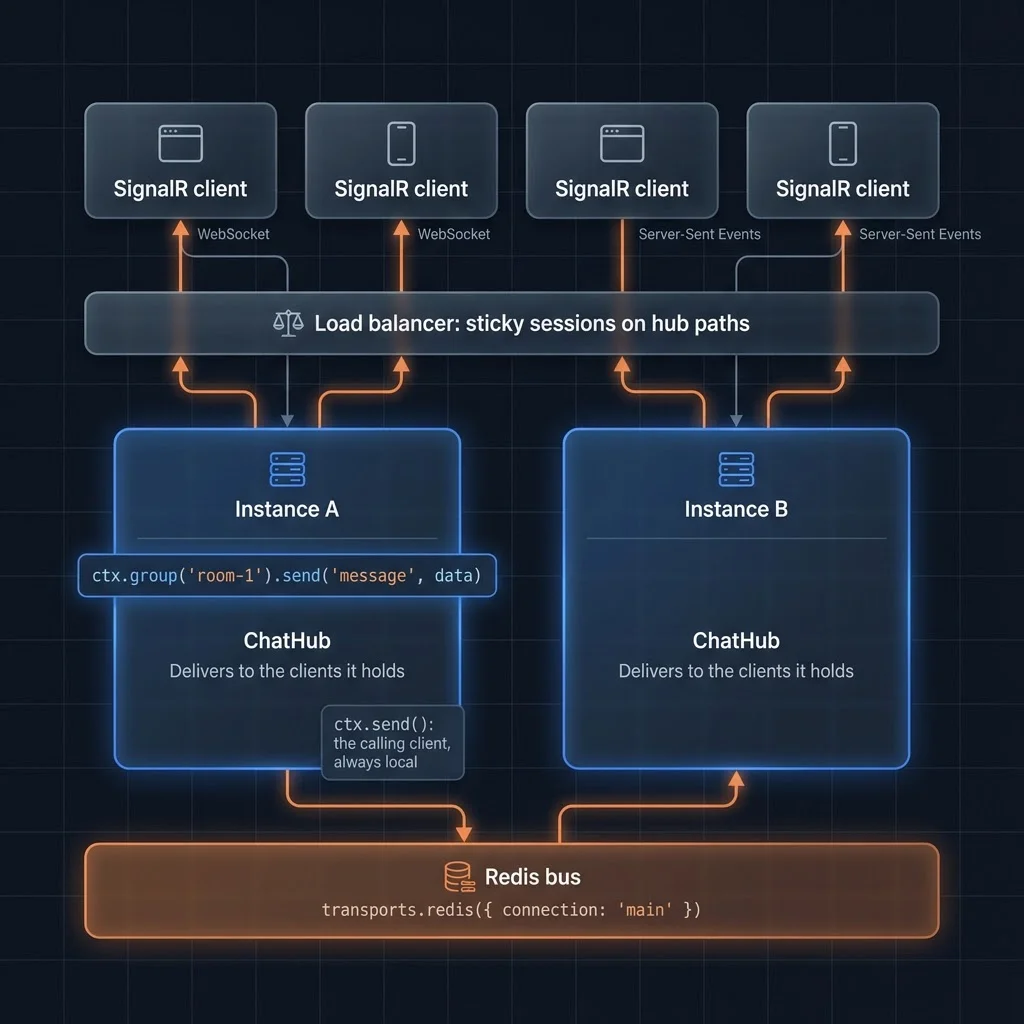
Hubs (SignalR)
A Hub is the bidirectional half: the client invokes methods on the server, the server pushes to one client, a group, or everyone. Mount it from a preload (start/services.ts), the same place registerRoutes() is called — each declaration mounts its route at the moment it is written, so before the server starts listening:
ts
import relay from '@c9up/relay/services/main'
import { Hub, type HubContext } from '@c9up/relay'

class ChatHub extends Hub {
  // `onSendMessage` handles the `sendMessage` invocation: the method name
  // after `on`, matched without regard to case.
  async onSendMessage(ctx: HubContext, data: unknown) {
    ctx.group('room-1').send('message', data)
  }
}

relay.hub('/hubs/chat', new ChatHub())
onConnect runs once the client's handshake has been answered — a frame sent before the handshake reply makes the SignalR client refuse the connection. A method's return value is what the client's invoke() resolves with.
A stream that has not completed the handshake within handshakeTimeoutMs (default 15 s, the client's own) is closed, and past maxConnections open streams (default 10 000) a new one is refused with 503. One owner — a user, or the client address of an anonymous request — may hold maxConnectionsPerOwner streams (default 20) and maxPendingTokensPerOwner negotiated tokens not yet attached (default 20); a full token table refuses a new negotiate with 503 rather than dropping somebody else's token. All are options of the adapter passed as the third argument:
ts
import { SignalRAdapter } from '@c9up/relay'

const hub = new ChatHub()
relay.hub('/hubs/chat', hub, new SignalRAdapter(hub, { handshakeTimeoutMs: 10_000, maxConnections: 2_000 }))
A connection's messages run one after another, in the order the client sent them. A client that sends faster than your methods answer builds a backlog on the server, and that backlog is bounded: past maxQueuedMessages messages waiting (default 256), a socket is closed with code 1013 and an upstream POST is refused with 429 E_RELAY_MAX_QUEUED. What was waiting is dropped.
Every message counts, including the ones packed into a single WebSocket message or a single POST. The SignalR client packs together the calls made while a send is in flight, so a client that fires more than 256 invocations without awaiting any of them is closed. Raise maxQueuedMessages for such a client, or have it await.
Guarding a hub
useGuards states what it takes to connect to the hub:
ts
class AdminHub extends Hub {
  constructor() {
    super()
    this.useGuards({ guards: ['session'], roles: ['admin', 'owner'], permissions: ['chat.moderate'] })
  }
}
The hub's own routes ask the guards. You mount nothing else for them to apply, and the order of your declarations does not matter.
| Where the guards are asked | What a refused client gets |
|---|---|
POST <path>/negotiate | 401 or 403, and no connection token |
The stream (GET <path>) and the WebSocket handshake | 401 or 403, and no stream or socket |
| Every invocation | an error event and an error Completion, then the connection is closed |
401 E_RELAY_UNAUTHORIZED answers a request that is not authenticated, or not through one of guards. 403 E_RELAY_FORBIDDEN answers an authenticated user without the role or the permissions.
A refused client is never registered on the hub. onConnect does not run for it, and it receives no ctx.broadcast() and no group send.
The guards read ctx.auth, so a middleware must fill it before the hub's routes run: a global one that authenticates without refusing, such as Warden's silentAuth. When nothing fills ctx.auth, every request is anonymous and a guarded hub refuses everyone.
guards names the guards the request may have authenticated through — what Warden reports as auth.authenticatedViaGuard. roles is satisfied by any of the names, permissions by all of them. The asymmetry is deliberate and is the same split the HTTP pipeline, the RPC router and the GraphQL engine use: a role names who someone is — an admin or an owner may act — while a permission names what an action needs, and it needs all of them.
A permissions guard asks the auth layer, as .permission() does on a route:
- When
ctx.authhashasAllPermissions(Warden's does, and asks the rights resolver), that answer decides. The permission list of the user payload is not read: a permission still written in a token's claims after it was revoked is refused. - Otherwise the list is read from
ctx.auth.permissions, or fromctx.auth.user.permissions. - When the request was authenticated with an access token, the token must allow each permission too. A token limited to
profiledoes not pass achat.moderateguard, even for a moderator.
To restrict one method of a hub that anyone may connect to, leave the hub without guards and check ctx.auth in the method.
What is checked again, and when
The guards are asked again on every invocation. An invocation they refuse ends the connection: the client no longer meets what it takes to be connected.
- Over Server-Sent Events, each invocation arrives on its own POST, authenticated afresh. A role or a permission removed since the stream opened is refused on the next call.
ctx.authin the method is that request's. - Over WebSockets, a connection has one request, its handshake. The role is the one the handshake carried. A permission is asked of the auth layer again on every call, so a permission removed mid-connection is refused on the next call.
Nothing is asked while a connection only listens. A user who logs out, or loses a role, keeps receiving until its next invocation, unless you end the connection yourself (see Ending a connection).
A POST must come from the user the stream was opened by, and a stream opened anonymously takes anonymous POSTs only (403 E_RELAY_NOT_OWNER). A token's first use — the stream or the socket — is held to whoever negotiated it: a token read in a log before its owner connects opens nothing. A POST for a connection that has no open stream is refused with 400 E_RELAY_NOT_CONNECTED.
Ending a connection
The server can end a connection. The client is taken off the hub at once, so it receives nothing more, then it is sent a SignalR Close and its stream or socket is closed.
ts
// In the logout handler, or where a role is removed:
adminHub.disconnectUser(user.id)

// One connection, by its id:
adminHub.disconnect(clientId)

// From a hub method, the calling connection:
async onLeave(ctx: HubContext) {
  ctx.disconnect()
}
disconnectUser() returns how many connections it ended. Both methods reach the connections held by the instance that runs them: a connection lives on the instance that negotiated it. Behind several instances, call them on each one.
Two connections end by themselves:
- A connection opened with an access token that expires (
ctx.auth.user.currentAccessToken.expiresAt) is closed when the token expires. - A connection whose
onConnectthrows is closed. The handshake POST answers500, a socket closes with1011.
onConnect / onDisconnect are lifecycle hooks and are not invocable. Mounting the same path twice throws rather than replacing the first hub.
Invocation arguments
A hub method receives every argument the client sent:
ts
class MathHub extends Hub {
  async onSum(ctx: HubContext, a: number, b: number, c: number) {
    return a + b + c
  }
}

// client: await connection.invoke('Sum', 1, 2, 3)   // → 6
A method declaring one parameter is unaffected — the extras are simply ignored, as in any JavaScript call. Only the first argument used to be passed, and the rest went nowhere without anything reporting it.
Arguments are parsed without __proto__ keys, and without a constructor object that carries prototype, at any depth. You can merge an argument into another object (Object.assign(settings, patch)) without the client changing that object's prototype.
The name is matched without regard to case, as SignalR clients expect: invoke('Sum'), invoke('sum') and invoke('SUM') all reach onSum. Two methods whose names differ only by case answer the same invocation, so the hub refuses to construct.
What is not supported
Streaming is not implemented. A StreamInvocation gets an error Completion naming the reason, rather than being dropped: the invocation id is the handle the client's observable waits on, and the protocol promises a Completion, so a dropped one leaves the observable pending for the lifetime of the connection.
StreamItem and CancelInvocation are ignored, which is the correct response for both — an item belongs to a stream whose opening invocation was already refused, and a cancel targets a stream that was never started.
The wire
Two first-class SignalR transports, so a stock @microsoft/signalr client speaks to a hub unchanged, whichever it picks:
| Route | Role |
|---|---|
POST <path>/negotiate | issues a connectionId + connectionToken, and the transports on offer |
WS <path>?id=<token> | WebSockets: one socket, frames both ways |
GET <path>?id=<token> | Server-Sent Events: the stream, server → client |
POST <path>?id=<token> | SSE's upstream: framed messages, client → server |
negotiate announces only the transports the server can actually serve: WebSockets first — SignalR tries them in order — when the server under the application can upgrade (server.supportsWebSockets(), true once ream's native server is listening), Server-Sent Events always. Advertising WebSockets while nothing can upgrade would send every client down a road that dead-ends. The socket and the SSE stream share the hub's path: ream hands a WebSocket handshake to the WebSocket route and a plain GET to the stream.
The socket carries the JSON protocol's text frames; a binary message is refused with close code 1003. ream's limits apply to it (config/app.ts → http.webSocket, see WebSockets), and SignalR's own frame limit (maxFrameSize, 64 KiB) inside them. On shutdown every socket is closed with 1001.
The route customizer passed to registerRoutes() applies to the routes of every hub mounted after it, the WebSocket one included. Use it for middleware all the realtime routes need. It is not what guards a hub:
- It is one customizer for every hub, so it cannot say "this hub needs
admin". - A hub declared before
registerRoutes()does not receive it. - Warden's
authmiddleware refuses nothing there. It enforces the@Guard,@Roleand@Permissiondecorators of a controller action. A hub route has none, so the request goes through.route.guard('web')does refuse an anonymous request, on every route the customizer reaches.
To decide who connects to a hub, use useGuards().